The Mustang Makes A Comes Back
By Tom Neal
Bigfoot Trails Basecamp | Independent Adventure Media
Fifteen years is a long time to leave a race car sitting. For my wife, Jahanel, it was long enough.
In March 2025, she made the decision to return to the dragstrip after a 15-year absence from competition. The reason was pretty simple: there was a narrow window of opportunity to share the staging lanes with her dad, who had been actively drag racing since the late 1960s. If we were going to make it happen, we had two weeks. We had a zero-dollar budget for racing upgrades, a three-hour one-way haul to the track, and no tow rig.
So we did what racers do. We started figuring out what absolutely had to be done, what could wait, and what we could probably get away with.
The original idea was pretty simple: get the Mustang down to Woodburn without having to borrow a tow rig, and have somewhere to sleep while we were there, so we bought a motorhome, and borrowed a trailer. It didn't take long for the motorhome to become more than just transportation. It became our pit basecamp. Eventually, the borrowed open trailer was replaced with a 24-foot enclosed trailer, and the whole setup started looking a lot more like something we could actually use for racing.
The car was a 1969 Ford Mustang with deep family roots. It had originally been restored from a bare shell in the late 1980s and had been developed a little at a time over the years before eventually going into a long hibernation. It wasn't some freshly built race car waiting in the shop. It was a car that had been sitting.
The Mustang had started life with a 250 inline-six. Over the years, it had evolved into a 351 Windsor, a C4 transmission, a narrowed Maverick 8-inch rear end, Granada front spindles and disc brakes, and a Ford Duraspark ignition. The problem was that fifteen years of sitting doesn't exactly make a car healthier.
We didn't have time for a complete preventative teardown. We woke it up, fixed what was obviously broken, crossed our fingers, and went racing.
That first season quickly reminded us why old race cars have a way of finding every weak link at the worst possible time. The 30-year-old Edelbrock carburetor failed. The electric fuel pump died. Old fuel lines decided they'd had enough. Then came the alternator, starter, and distributor failures. And eventually, the transmission gave up completely in the middle of the season.
There were also constant problems with throttle response, which meant more time in the pits trying to make the car behave and less time worrying about dial-ins. It wasn't exactly the smooth return to racing we'd imagined.
But through all of it, Jahanel stayed in the driver's seat.
That was really the point of the 2025 season. The car needed work, but she needed seat time. You can have the best car in the world, but bracket racing still comes down to the person sitting behind the wheel. The more passes she made, the better she got at adapting to whatever the Mustang decided to do that day.
Eventually, all those passes started paying off. Despite the mechanical problems, the late nights, the broken transmission, and everything else the car threw at us, Jahanel earned an invitation to the ET Finals in Mission, British Columbia.
We were back.
Now we just needed to make the damn thing reliable.
That became the plan for 2026. No cosmetics. No wasting money on things that didn't make the car faster, safer, or more predictable. The goal was simple: runability, reliability, and consistency.
The C4 transmission was rebuilt and went back into the car. New AFR aluminum cylinder heads were going on, along with a new camshaft, lifters, pushrods, and supporting valvetrain components. We had fresh Mickey Thompson ET Street tires waiting. There were plans for the front suspension, more tuning, and eventually a better carburetor. The idea was to take everything we'd learned from the 2025 shakedown season and build a more consistent combination.
Of course, that's about when life decided to get involved.
I didn't get nearly as much work done over the winter as I'd planned. My brain and nervous system had other ideas, and I wound up spending unexpected time in the hospital, including a stint in the ICU and brain surgery. I wasn't exactly in race-car-building shape.
So the Mustang went to my brother-in-law's shop, and he stepped in to help keep the build moving. While I was stuck recovering, I found another way to stay involved. I built a race-log spreadsheet from bed.
It was basically a digital logbook with formulas that could break down each run, account for weather and track conditions, and help predict what the car should run and what the next dial-in might look like.
Racing and spreadsheets. That pretty much sums up the modern bracket racer.
The engine build came together, and when he fired it for the first time, it sounded great. The new AFR heads immediately improved throttle response and power delivery. For a moment, it looked like we'd actually gotten ahead of the game.
Then he found the next weak link.
On the second test outing, my brother-in-law took the Mustang out with his 16-year-old son, an accomplished young racer who already had 24 Wallys to his name. They put the car under load. The 275 drag radials lit up. The car went sideways and drove both of them hard into the seat. Smoke filled the air.
But not all of it was tire smoke.
Oil started pushing out of the valve covers.
That wasn't good.
The engine had originally been assembled by me more than 25 years earlier. It had run strong in its original configuration and had survived various changes over the years. But it had also sat for a long time.
The top-end upgrade had done exactly what we wanted it to do. The engine was moving more air and making more power. It had also exposed the weakest part of the combination.
The rings.
The ring seal had degraded during all those years of sitting, and the new top end had finally pushed the old bottom end far enough to reveal the problem.
So the engine came back apart. We sourced a bottom-end rebuild kit, he pulled the engine, inspected the cylinders, gave it a light hone, replaced the rings and main and rod bearings, and started putting it back together.
Build it. Test it. Break it. Fix it. Make it better.
That pretty much became the 2026 plan.
Eventually, he got the Mustang back together. He finished the final details just twenty-four hours before heading for Woodburn Dragstrip.
The plan was to get through the gates Friday morning, use the Test 'n' Tune session to establish a baseline, work on the timing and carburetor, adjust tire pressure, and figure out what the new combination wanted.
Then the rain came.
Friday's test session was a complete washout.
Saturday morning, the race officials gave us one practice round. Then we were going straight into eliminations. For a car with a freshly rebuilt engine and transmission that had never made a pass down the track, that was about as bad a hand as we could have been dealt.
There wasn't much choice. We had one shot to make the practice run count.
Jahanel pulled into the burnout box and started heating the tires. The car immediately backfired through the intake. Flames shot out of the hood scoop. The engine died.
We got it refired, completed a quick burnout, and staged. The tree came down. She hit the throttle.
The car died again.
The starter gave her another shot. She staged a second time.
Green light. Throttle.
Dead again.
Back to the pits.
I started digging.
The timing was way too retarded, so I advanced it and adjusted the carburetor. Then I took the Mustang down the warmup return lane for a quick test.
The second I touched the throttle, those new Mickey Thompson ET Street tires shredded the pavement.
The power was there. We just needed to get it down the track.
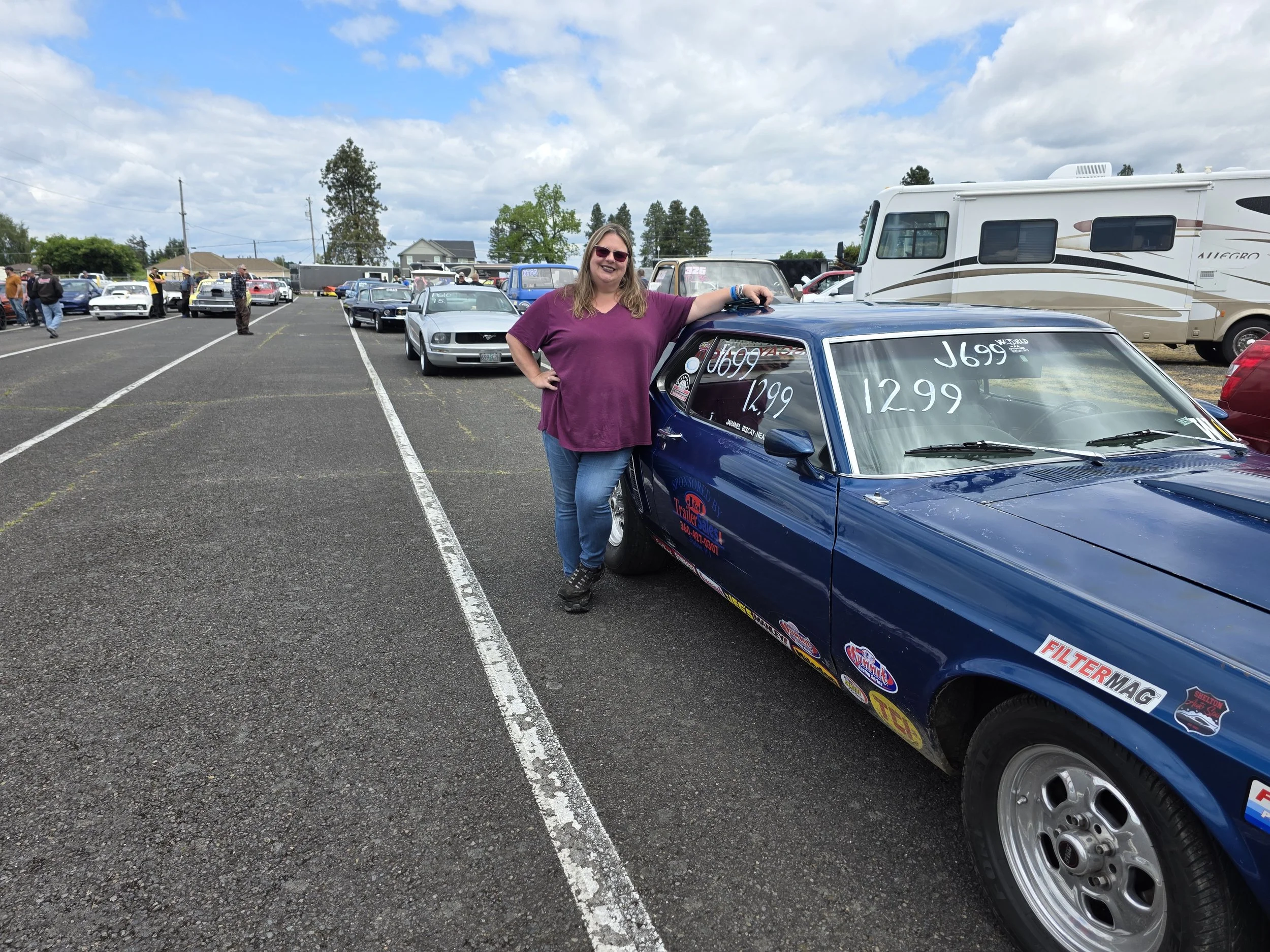
With zero clean passes on the new combination and no real baseline, we had to guess at the first-round dial-in. I told Jahanel to put a safe 12.99 on the window and be ready to lift if she needed to.
She drew a Mercedes dialed at 15.89. Being the quicker car, the plan was simple: catch him, hold him at the stripe, and lift at the end.
It didn't matter.
The other driver red-lit. Jahanel got the free pass and drove the Mustang out the back door.
12.92.
Even with a heavy stumble right off the starting line.
The second round paired her against our sister-in-law. Jahanel red-lit that round, but the car delivered another solid pass.
By Sunday, the Mustang was starting to show us what it could really do. 12.90s. 105 to 107 miles per hour.
After everything we'd been through just to get the car back to the track, seeing those numbers on the timeslip felt pretty damn good.
We wanted the car in the 12s this year.
We'd gotten there.
And now, naturally, we wanted more.
The engine has more power in it. The trap speed tells us that. The chassis is probably the biggest thing holding the car back now.
There are already plans for the off-season: subframe connectors, a complete front spring overhaul, CalTracs and split-monoleaf springs in the rear, and better adjustable shocks. Once the chassis can plant the power, we'll start looking at the carburetor and ignition again.
Because hot rods are never done.
We also have a couple of small upgrades that will go on before the next race, and there's an aluminum radiator waiting for some custom fabrication work.
And somewhere down the road, there's always the question of the engine. If the current combination survives long enough to get properly broken in, maybe we'll see what it can really do.
If it breaks instead?
Well...
Maybe it's time for a stroker.
Can we say tens?
It's good to have goals. Sometimes dreams. Sometimes delusions.
The Mustang wasn't the only family car making a comeback in 2026, either. My brother-in-law brought out his 1965 Falcon Sedan Delivery, the first car he ever owned. He got it when he was fourteen years old.
That car had been off the track for roughly five years. It came into the season dialed for the 10.50s and eventually laid down four consecutive 10.44 passes, with a best of 10.40.
Then my nephew brought out the family's legendary '54 Glasstop, a 1954 Ford Skyliner that has been in the family since 1969. That car spent years making passes at Bremerton Raceway and Pacific Raceways. Now it's making noise at Woodburn.
Standing around the track and seeing all these family cars together makes something pretty obvious.
This isn't just a bunch of people who happen to like drag racing. It's generations of the same family showing up with cars they've owned for decades.
Cars get handed down. Knowledge gets handed down. Stories get handed down. And apparently, the addiction gets handed down too.
The Mustang that Jahanel pulled out of blackberry bushes as a teenager is still out there. Her dad is still racing. Her brothers are still racing. The next generation is already racing. And now the grandchildren are being introduced to Jr. Dragsters.
Four generations of drag racers. Nearly sixty years of racing.
And we're still hauling the cars to the track, breaking shit, fixing it, spending money we probably shouldn't, and coming back the next weekend to do it all again.
I guess some things never change.
ABOUT THE AUTHOR
Tom Neal is the founder of Bigfoot Trails Basecamp, an independent adventure media project built around real experiences. He’s spent most of his life around vehicles, motorcycles, racing, travel, and projects that tend to take longer and cost more than originally planned.
After decades of doing all that stuff, he’s learned that the best stories usually aren’t the ones you planned. They’re the people you meet, the places you stumble across, the things that go wrong, and the moments you never expected.
That’s what he wants to capture with BTB.
He doesn’t want to write about adventure from the outside. He wants to go experience it, then tell you what happened.
Bigfoot Trails Basecamp | Independent Adventure Media