
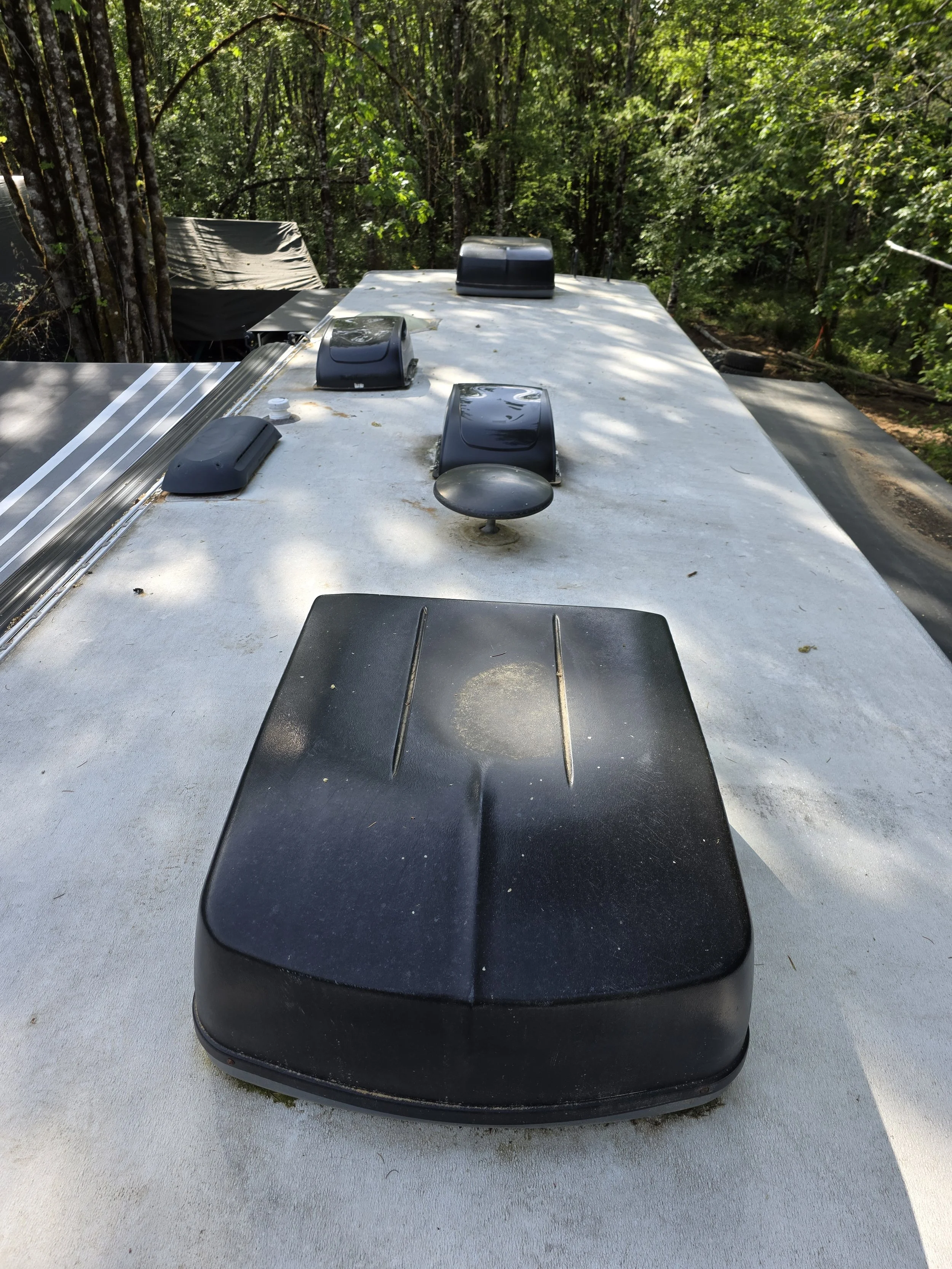
One of the bigger projects on the list for our 2015 Georgetown is figuring out the HVAC.
The front/main living-area air conditioner failed last summer, which was pretty much the worst possible timing. We were in the middle of race season, parked in direct sun, and still had plenty of hot-weather camping ahead of us. Naturally.
The rear bedroom unit still works, so we're not completely without A/C. But this isn't something I want to patch together forever. We're living in this motorhome, and I want the HVAC system to be quieter, more efficient, and more useful when we're camping without hookups.
The problem is that I have way too many ideas.
Option 1: A Residential Mini-Split
At our previous house, I had a mini-split heat pump system and absolutely loved it.
It was quiet, efficient, and did both heating and cooling without the racket and cycling I was used to from traditional HVAC.
That got me wondering:
Could I put a residential-style mini-split in the RV?
Technically, I'm pretty confident I could make it work.
The problem is that "I can make it work" and "this is a good RV solution" are two very different things.
A residential system would mean figuring out indoor and outdoor unit locations, refrigerant lines, electrical requirements, condensate drainage, mounting, weatherproofing, and how to integrate everything cleanly into the motorhome.
At that point, I'm no longer replacing an RV air conditioner.
I'm redesigning the HVAC system.
That's an interesting project for me, but it isn't necessarily the kind of solution I want to recommend to someone who just wants their RV to stop cooking them.
Option 2: Rooftop Heat Pumps
The more conventional solution is replacing the existing rooftop A/C units with newer rooftop heat pumps.
This is probably the most straightforward approach.
Instead of having separate equipment for cooling and heating, a heat pump can provide:
Air conditioning in hot weather
Electric heat when temperatures are moderate
The RV's propane furnace as backup when it gets too cold for the heat pump to make sense
Since our Georgetown already uses Dometic equipment, staying with Dometic also appears to simplify the installation.
The big advantage here is that I'm not reinventing the RV.
Remove the old rooftop unit, install the new one, deal with the controls and thermostat, and get back on the road.
That's hard to argue with.
Option 3: Move the Working A/C and Add 12V A/C
This is the option that keeps getting stuck in my head.
The bedroom rooftop unit still works.
So instead of replacing everything immediately, what if I moved that unit?
The basic idea would be:
Remove both existing rooftop units.
Move the working rear unit to the main living area.
Install a 12V air conditioner in the bedroom.
Build the electrical system around the new setup.
The reason the 12V bedroom A/C is interesting has less to do with cooling the bedroom at home and a lot to do with race weekends.
Our generator can't run all night at the track. If we could cool the bedroom using a 12V system powered from the house batteries, that could give us a much quieter overnight setup.
And that's a real-world problem I actually want to solve.
The Front A/C Isn't Completely Dead
I did try to repair the existing front unit.
I replaced the start/run capacitor, and technically, it came back to life.
Sort of.
It cools, but nowhere near as well as it should.
My suspicion is that the refrigerant charge may be low. Unfortunately, these rooftop RV units aren't exactly like working on an automotive A/C system where you can hook up a gauge set and easily diagnose and service the system.
So while I got it functioning again, I don't consider the problem solved.
What Makes the Decision Difficult
All three approaches have something going for them.
Residential mini-split: potentially the quietest and most efficient option, but it's also the biggest custom project.
Rooftop heat pumps: probably the cleanest and most practical replacement, especially if I stay with the equipment already in the Georgetown.
Relocated rooftop unit + 12V bedroom A/C: potentially the most interesting solution because it addresses both everyday RV living and our race-weekend power limitations.
And that's where I am right now.
I haven't decided shit.
I'm not going to pretend I have the answer just because I wrote an article about the problem.
This is still a project I'm researching, measuring, and figuring out.
When I finally pick a direction, I'll document why I chose it, what the installation actually took, and whether the finished system works as well as I expected.
Because that's ultimately what I'm interested in with BTB.
Not telling you what you should buy.
Showing you what I actually did, what worked, what didn't, and what I'd change if I had to do it again.
Adventure isn't a product. It's an experience. Sometimes the experience starts with figuring out how the hell to keep the RV cool.