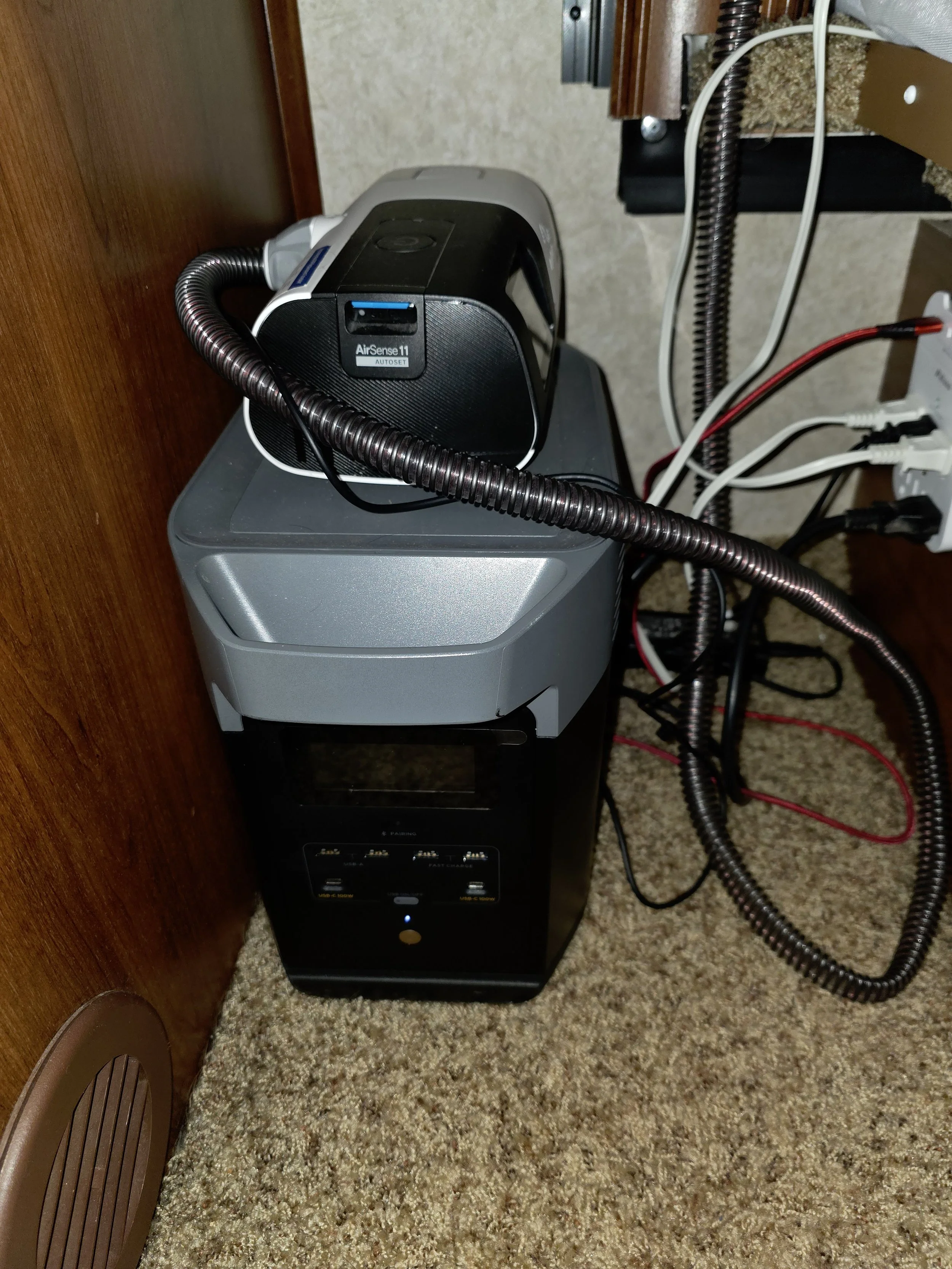
We didn't buy an EcoFlow DELTA 2 because it was shiny or because everybody else seemed to have one.
We bought it because we had a problem.
At NHRA races, generators have to be shut down at 10 p.m. My wife uses a CPAP, and that's not exactly something you can turn off when the campground gets quiet.
We needed a way to keep the CPAP running through the night without running a generator next to the RV.
The DELTA 2 seemed like a good solution.
After using it for a while, we've learned something important:
It's damn good at some jobs and completely wrong for others.
Why We Bought It
The original mission was pretty simple: quiet overnight power.
No generator noise.
No fuel.
No exhaust.
No extension cord running through an RV window.
Just enough battery power to keep the CPAP running while everybody else in the campground is supposed to be quiet.
That was the problem we needed to solve.
Then we started finding other uses for it.
EcoFlow to the Rescue
One of those uses came during a particularly screwed-up race weekend.
We'd had another setback with the Mustang engine build right before a double-header points weekend. The Mustang wasn't going to make it, but my wife still wanted to race, so she took the Kia Sorento instead.
I stayed home.
She was camping in her dad's trailer, temperatures were expected to drop to around 38°F, and she needed her CPAP.
So I sent the DELTA 2 along with her.
I also sent some REI cots, Therm-a-Rest sleeping pads and a small heater. Two adults sleeping directly on a trailer floor wasn't happening if I could help it.
The DELTA 2 handled the CPAP without requiring a generator to run through the night.
That's exactly what we bought it for.
Then I Tested the Whole RV
Eventually, I wanted to know what the DELTA 2 could do beyond a CPAP.
So I hooked it into the motorhome and let it run the RV.
The TV was on, and the refrigerator was still running on electric because I hadn't switched it over to gas for the test.
The result?
About two hours.
That's obviously nowhere near enough to power the whole motorhome overnight.
But it was a useful test because it showed exactly where the limitations are. A Class A has a lot more electrical demand than a CPAP, and things like refrigerators, televisions and other appliances add up quickly.
It also wasn't intended to be a laboratory test. It was simply me plugging the thing into the RV and seeing what happened.
And that's generally how I test shit.
The CPAP Test
The opposite end of the scale was much more interesting.
Running the CPAP by itself, the DELTA 2 lasted approximately four nights without a recharge.
That's a completely different result.
For a low-power overnight load, the DELTA 2 has plenty of capacity for what we originally bought it to do.
I still need to do a clean test with both CPAPs running overnight, because that's ultimately the configuration I'm interested in.
So Where Does It Fit?
I've stopped thinking about the DELTA 2 as an RV generator replacement.
It's better to think of it as portable supplemental power.
For us, that means:
CPAPs
Phones and tablets
Laptops
TV
Lights
Other small electronics
Short-term backup power
Quiet-hour power at the races
It can handle higher-draw equipment for short periods, too, but that's where battery capacity disappears quickly.
Yes, you can run a microwave from it.
You just shouldn't be surprised when the battery percentage drops like a rock.
And no, I'm not expecting it to run our RV air conditioner overnight.
That's not what we bought it for.
What I Want to Do Next
I'd eventually like to add a second DELTA 2 and link the two systems together.
The goal is pretty specific: enough capacity to run both CPAPs overnight without starting a generator.
I haven't tested that configuration yet, so I'm not going to claim that it works.
That's the next experiment.
The larger Georgetown electrical project will eventually involve a much more substantial house-battery and charging system. The DELTA 2 isn't replacing that.
It's another layer.
And I like having layers.
The Bottom Line
After actually using the DELTA 2, I think it's important to understand what you're buying.
It's not a magic box that turns a portable battery into a whole-house electrical system.
Our own testing makes that pretty damn clear:
CPAP only: approximately four nights.
Whole RV with the TV and electric refrigerator running: approximately two hours.
Those numbers aren't contradictory. They're simply two completely different electrical loads.
For the job we originally bought it to do — quiet, reliable overnight power for a CPAP — it's been a very useful piece of equipment.
And the fact that I can throw it in the truck or trailer and take that power somewhere else makes it even more useful.
That's the kind of gear I like.
Not something that promises to do everything.
Something that does the job I actually need it to do.
And now I want to see what happens when I give it a second battery and two CPAPs to deal with.