Camco vs. Rhino: The RV Sewer Hose Setup I Actually Ended Up Using
By Tom Neal
Bigfoot Trails Basecamp | Independent Adventure Media
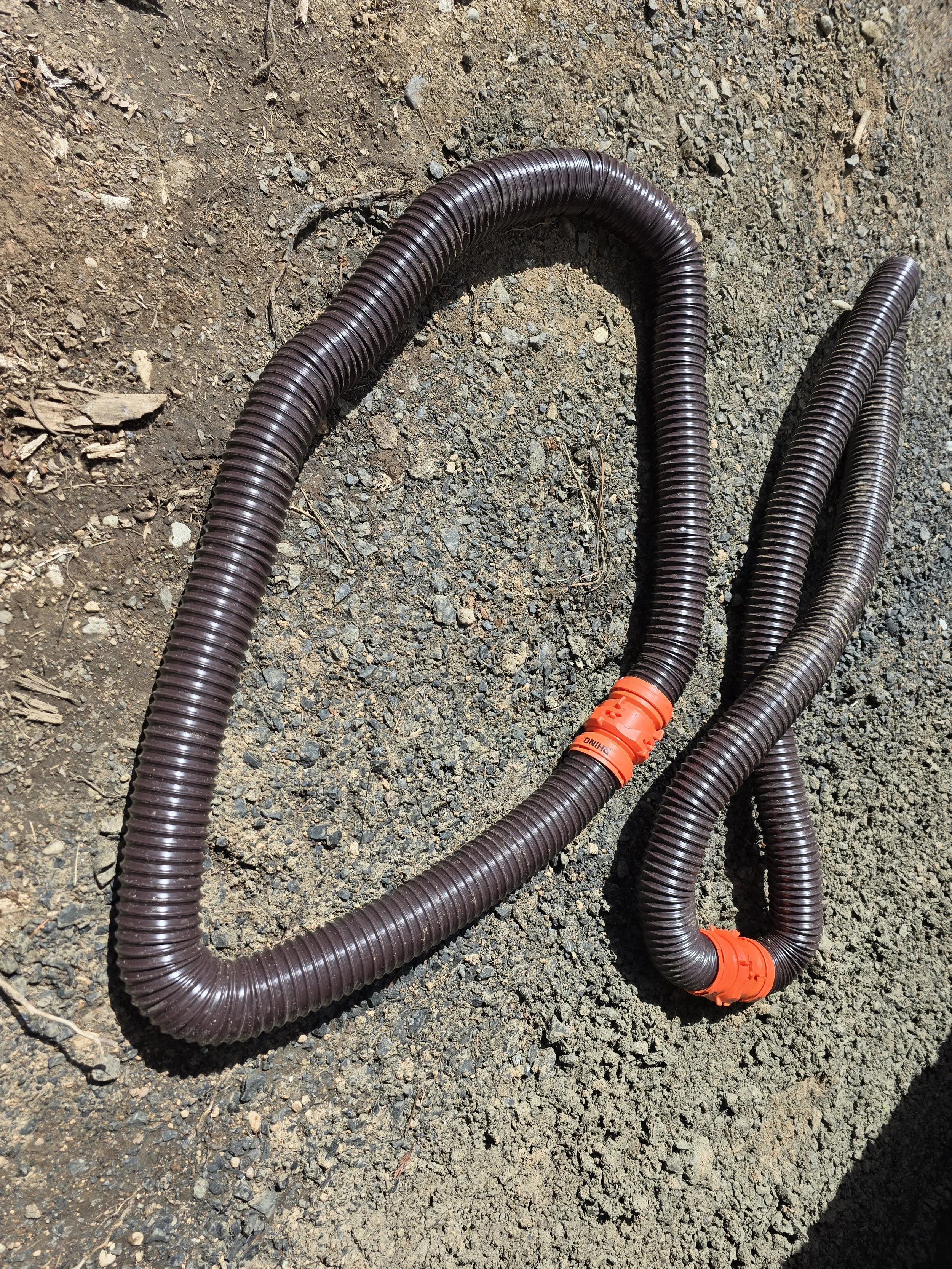
When we bought our RV, it came with a pair of Camco sewer hoses. I don't know exactly how old they were at the time, but they had obviously been around for quite a while. By the time I eventually replaced them, they were probably eight years old, give or take. I had only owned the RV for about a year and a half, so most of those years were somebody else's.
The last year and a half, though, they were mine, and they got used.
They went through hookups, dump stations, repositioning the RV, breaking everything down and setting it back up again. Basically, they were being used the way an RV sewer hose is supposed to be used. I never really gave much thought to replacing them because, as far as I was concerned, they worked.
Then I ran into a pretty simple problem.
I needed another foot of reach.
One of my setups required a little more hose than the two Camco sections could give me, and I didn't really want to replace the whole system just to gain another foot. So I picked up a Rhino hose kit at Walmart or Tractor Supply, about a year before I eventually retired the old Camcos.
That turned out to be a pretty good decision, because now I had two different hose systems sitting around the RV, and over time I started using both of them depending on what I was doing.
The Rhino is a different style of hose than the Camco. It's more of a collapsible "scrunch" design, and when it's fully extended it works really well, especially if you're making a straight run. There was one thing I noticed pretty quickly, though. When I opened the valve, the Rhino wanted to expand. It would push itself outward more aggressively than the Camco.
It wasn't a problem, and after using it a few times I learned to expect it. It was just one of those little characteristics you don't think about until you're standing there trying to keep a sewer hose where you want it while the tanks are doing their thing.
Most of my setups require two hose sections anyway, so I'm rarely running one long, perfectly straight hose. That's when I started noticing that, even though the Rhino worked just fine, I still preferred the old Camcos.
Some of that was probably familiarity. I'd been using those hoses long enough that everything about them had become second nature. They coiled the way I liked, they stored nicely, and the fittings had been used enough that they were easy to hook up and disconnect.
That's something you don't really learn from a specification sheet. You learn it by standing there using the damn thing over and over again.
There were things about the Rhino that I liked better, too.
The clear elbow was one of them.
My Camco setup had the gray-and-yellow elbow, and it worked fine. But I liked the clear Rhino elbow because I could actually see what was happening inside the connection. That doesn't sound like much until you're standing there dumping tanks and wondering whether everything is actually moving through the line the way it should.
So the clear Rhino elbow became part of the setup.
For a while, I was perfectly happy running a combination of the two systems. Then one of the old Camco hoses finally gave me a reason to retire it.
I noticed a leak near the fitting end. There was a split right at the connection, and when the initial discharge pressure hit the hose, it would spray.
Fortunately, I caught it quickly.
At that point the Rhino wasn't just the hose I'd bought because I needed another foot of reach. It became the system I was relying on while I figured out what I wanted to do with the old Camcos.
There was another piece of the setup I'd already settled on by then. I had a Camco flush valve that I preferred over the Flush King I'd previously tried. The Flush King failed after the third use, so that experiment didn't last very long.
After living with both hose systems for a while, I realized I still didn't really want to pick a winner.
The Rhino worked. It solved the reach problem, and I liked the clear elbow. The Camco hoses were still my preference for handling, coiling, and storage. Neither one had everything I wanted, and neither one was bad enough that I wanted to get rid of the other.
Eventually the old Camco hoses were done, though, and I had to replace them.
I went back to Camco.
So that's what I'm running now: new Camco hoses, the Camco flush valve, and the Rhino clear elbow.
A little bit of both.
And honestly, that makes more sense to me than trying to declare one brand the winner.
I've actually used both systems. Not for a weekend camping trip and not just long enough to take some pictures and write a review. They've been part of my RV life. The old Camcos had already survived years before they ever became mine, and then I put another year and a half of real use on them before one finally failed at the fitting.
The Rhino did exactly what I needed it to do when I bought it. It gave me the extra reach, it worked, and I found a piece of the system I liked enough to keep.
But when it came time to replace the hoses, I still bought Camco.
I guess that's probably what I learned from using both. Sometimes there isn't a winner. Sometimes you use something long enough to figure out what works for you, what doesn't, and which pieces you actually want to keep.
For me, that ended up being Camco hoses, a Camco flush valve, and a Rhino clear elbow.
It's not exactly a brand loyalty test.
It's just the setup that works.
And out here, that's really all I'm looking for.
It's not theory. It's use.
ABOUT THE AUTHOR
Tom Neal is the founder of Bigfoot Trails Basecamp, an independent adventure media project built around real experiences. He’s spent most of his life around vehicles, motorcycles, racing, travel, and projects that tend to take longer and cost more than originally planned.
After decades of doing all that stuff, he’s learned that the best stories usually aren’t the ones you planned. They’re the people you meet, the places you stumble across, the things that go wrong, and the moments you never expected.
That’s what he wants to capture with BTB.
He doesn’t want to write about adventure from the outside. He wants to go experience it, then tell you what happened.
Bigfoot Trails Basecamp | Independent Adventure Media